Highlighted Publications
Epithelial interferon-stimulated gene programs modulate chemotherapy sensitivity in colorectal cancer via EPSTI1
2026
Oncogene
Erkan EP, Hamalainen E, Kolikova J, Nikupaavola T, Sajnani K, Kuc K, Ojala K, Kukkonen M, Hermelo I, Kurttila A, Koskensalo S, Tarvainen T, Leppa A, Keranen I, Haapamaki C, Karjalainen E, Carpelan-Holmstrom M, Renkonen-Sinisalo L, Koskenvuo L, Puolakkainen P, Mecklin JP, Vayrynen JP, Virolainen E, Nykter M, Aaltonen LA, Urbanucci A, Lepisto A, Ristimaki A, Seppala TT
We used patient-derived tumor organoids to study the molecular factors underlying heterogeneous chemotherapy responses in colorectal cancers. We identified an epithelial interferon-stimulated gene (ISG) program, linked to high JAK–STAT signaling, that was associated with reduced sensitivity to standard-of-care chemotherapy. JAK–STAT signaling was further modulated by neoadjuvant chemotherapy, with EPSTI1 emerging as a key effector. Loss-of-function experiments demonstrated that EPSTI1 depletion reduced cancer-cell viability and increased chemotherapy sensitivity. These findings nominate the JAK–STAT–EPSTI1 axis as a potential therapeutic target and demonstrate the value of patient-derived tumor organoids for uncovering tumor-intrinsic mechanisms that shape treatment response in colorectal cancer
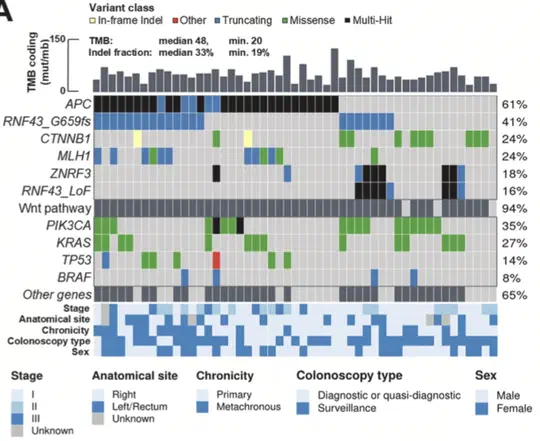
MLH1 Lynch Syndrome Colorectal Cancers Are Driven by Heterogeneous Wnt Pathway Gene Mutations
Lynch syndrome–associated colorectal cancers in MLH1 mutation carriers are driven by somatic mutations in Wnt signaling pathway genes. This study reveals that these mutations are heterogeneous across tumors, highlighting Wnt pathway dysregulation as a central but diverse oncogenic mechanism in MLH1-deficient hereditary colorectal cancer.
NOUS-209 Off-the-shelf Immunotherapy Has the Potential to Hit Primary and Metachronous Colorectal and Urothelial Cancers in Lynch Syndrome
2026
Mol Cancer Ther
People with Lynch syndrome inherit a high risk of several cancers, and their tumours carry distinctive protein fragments produced by a common DNA copying error. The experimental vaccine NOUS-209 trains the immune system to recognise 209 of these shared fragments. Sequencing 73 bowel and bladder tumours from 58 people with Lynch syndrome showed the vaccine targets were plentiful in both tumour types and in first as well as later cancers; over time the immune system appeared to clear the most recognisable ones, yet every new tumour produced fresh targets the vaccine could hit. The findings suggest NOUS-209 might help prevent both first and repeat Lynch syndrome cancers, including bladder cancer, not only bowel cancer.
Recent Publications
2026
Virchows Arch
2026
Eur J Cancer
Marchetti C, Gultekin M, Sassu CM, Planchamp F, Ellis LB, Bowden SJ, Theodoulidis V, Kesic V, Ataseven B, Scambia G, Lecuru F, Genuardi M, Dominguez-Valentin M, Seppala TT, Amant F, Grigore M, Polterauer S, Temiz BE, Ege HV, Duranti S, Bizzarri N, Didelot H, Pauly N, Seebacher-Shariat V, Manchanda R, Kyrgiou M
2026
Ann Med
2026
Cancers Basel
2026
Int J Cancer