Abstract
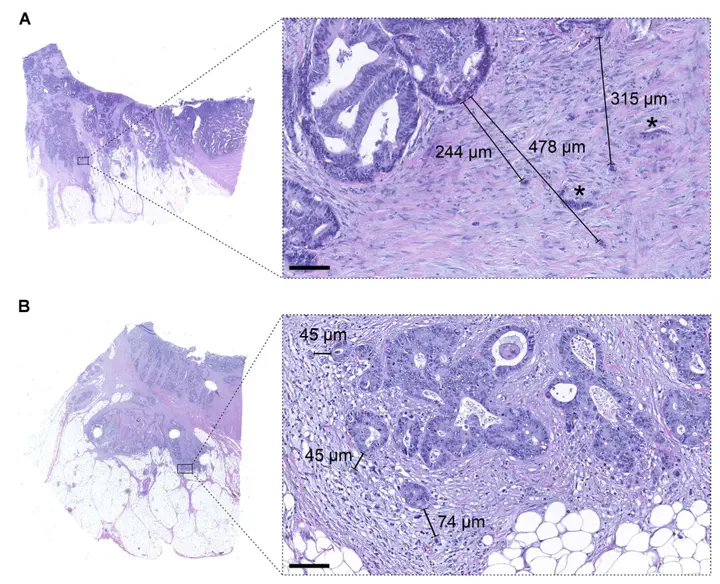
Colorectal cancer cells sometimes break away from the main tumor and spread outward as tiny clusters — a phenomenon pathologists call tumor budding. Researchers studied not just how many of these buds exist, but how far they travel from the tumor’s edge, introducing a new measurement called TB-distance. Across nearly 1,900 patients in two independent groups, tumors with buds that spread farther were more aggressive and linked to shorter survival. However, this distance measurement did not add predictive power beyond what standard tumor budding counts already reveal, suggesting it may be most useful as a visual tool for pathologists or as a feature in future computer-assisted cancer analysis.
Type
Publication
Virchows Arch